Manufacturing processesReading time 12 min
What a laser will cut, and what it will not
A laser is not a universal tool. Whether it can process a material is decided first not by power, but by whether that material absorbs that wavelength.
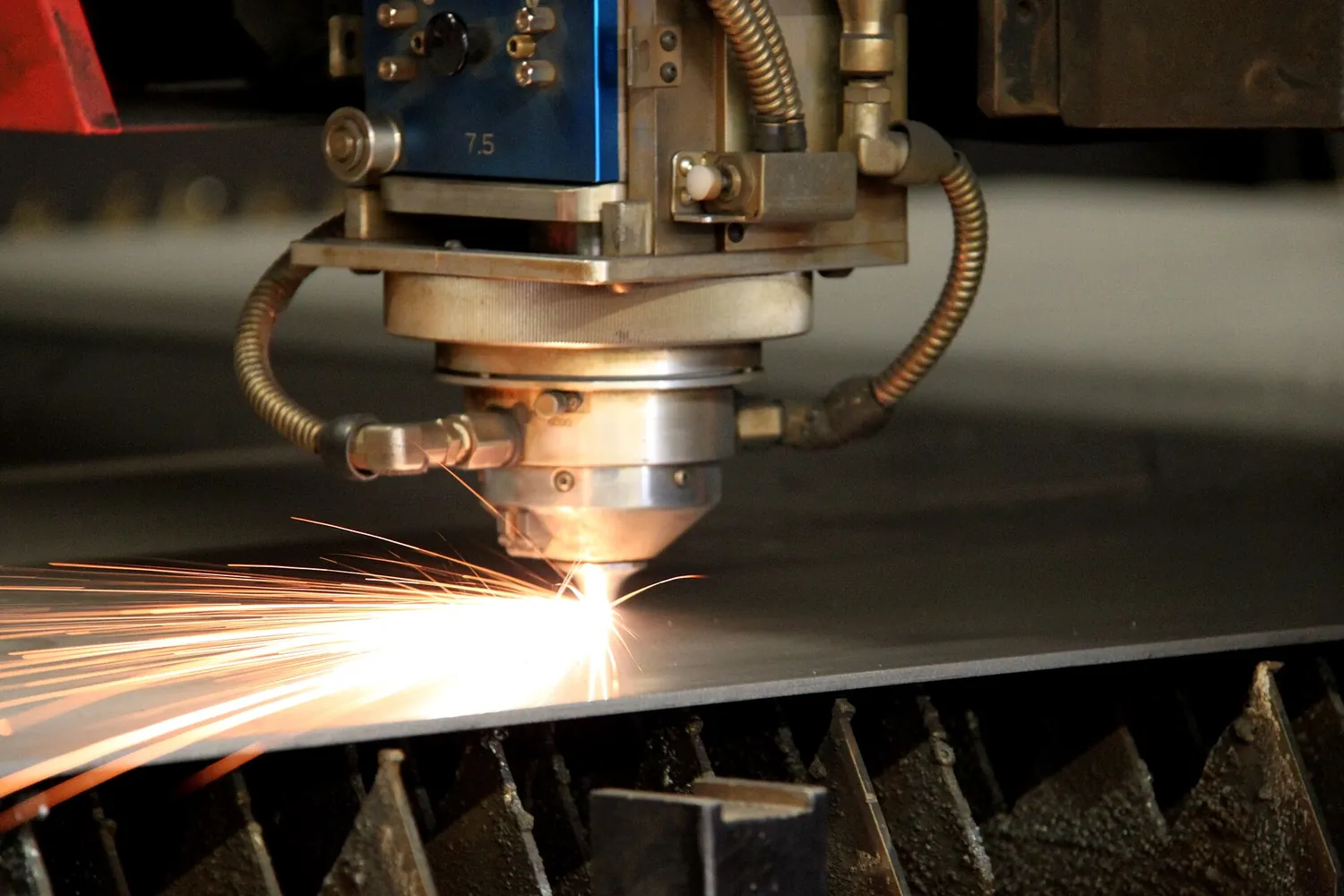 Wikimedia Commons・Laserkop van Amada FO-4020NT 4kW・CC0
01Three mainstream lasers
| Type | Wavelength | Good at | Poor at |
|---|---|---|---|
| Fibre | About 1.06 μm | Metals: carbon steel, stainless, aluminium, copper, brass | Most plastics, wood, glass |
| CO₂ | 10.6 μm | Non-metals: acrylic, wood, leather, fabric, paper | Highly reflective metals |
| UV | 355 nm | Cold processing: films, glass, ceramics, fine plastics | Cutting thick sections |
Metals absorb far more at around 1 μm than at 10.6 μm, which is why metal is cut with fibre lasers while acrylic and wood are the other way round. Copper and brass remain highly reflective even to fibre; early fibre machines risked reflected light returning into the resonator, and most models now include an isolator before anyone will cut copper.
02How to judge cut quality
- Kerf width. Affects nesting spacing and finished size; the program has to compensate.
- Taper. On thick plate the kerf differs top to bottom, and the tolerance has to allow for it.
- Dross. Molten residue on the lower edge, needing secondary work.
- Striation. The ripple pattern on the cut face, showing whether speed and gas pressure are matched.
- Heat-affected zone. The region where the microstructure changed, affecting later bending and welding.
| Assist gas | What it does | Typical use | Cut face |
|---|---|---|---|
| Oxygen | Exothermic oxidation, supports burning | Medium-thickness carbon steel | Oxide layer present, must be cleaned before welding |
| Nitrogen | Blows the melt away and excludes oxygen | Stainless, aluminium | Oxide-free, weldable as cut |
| Air | Cheapest | Thin sheet, non-critical parts | Slight oxidation |
03Laser marking: readability is the specification
The aim of marking is not that the mark goes on, but that it can be read afterwards, especially where DataMatrix or QR traceability is required. ISO/IEC 29158, the DPM quality guideline, scores it on a set of indicators.
| Metric | What it looks at |
|---|---|
| Cell Contrast | Contrast between cell and background |
| Cell Modulation | How consistent the cell brightness is |
| Fixed Pattern Damage | Whether the finder pattern is intact |
| Axial Non-uniformity | Whether the code's aspect ratio is distorted |
| Grid Non-uniformity | Whether the grid positions have drifted |
Marking mechanisms by material
- Annealing. Heat discolours the surface by oxidation without removing material. Suits stainless and titanium, keeps the surface flat and corrosion resistant, common on medical devices.
- Engraving. Melts and vaporises material to form a groove. High contrast, but the surface is damaged.
- Foaming. Heat produces bubbles in plastic, giving a lighter mark.
- Carbonising. Organic materials char and darken under heat; suits wood and leather.
04Laser-related callouts on the drawing
A few things on the drawing of a laser-cut part are easy to overlook and directly affect the process.
- Thickness and material decide the machine, the power and the gas.
- Minimum internal radius. Laser cutting has a minimum internal corner radius, roughly the kerf width. A sharp corner on the drawing cannot actually be made.
- Hole diameter against thickness. The usual rule is that hole diameter should not be less than the thickness, or the cut is not clean.
- Cut face roughness or dross requirements. If the drawing gives an Ra value, secondary work may be needed.
- Marking content, character height and position, including serial number rules and whether a barcode is required.